

From Google to GPT: How AI Search Is Shifting Power From Acquisition to Retention
Shoppers are changing how they discover products online. AI tools like ChatGPT and Gemini now lead 31% of product searches, overtaking traditional search engines (21%). This shift compresses the shopping journey into a single AI-driven interaction, where users receive tailored recommendations instead of browsing multiple links. But this change doesn’t just affect discovery – it’s reshaping how businesses grow.
Key trends include:
- AI-driven traffic is surging: Retail sites saw a 4,700% increase in traffic from AI tools between July 2024 and July 2025.
- Fewer brands are visible in AI recommendations: Only 10–15% of brands benefit from AI referrals, with limited slots for recommendations.
- Acquisition costs are rising: Paid ads on AI platforms demand steep investments, with OpenAI’s beta ads requiring $200,000–$250,000 to participate.
Retention is now more critical than ever. Brands must focus on keeping existing customers engaged through first-party data and predictive AI tools. Retention strategies are not only more cost-effective but also help businesses stay competitive in an AI-dominated market. For example, companies using AI retention tools report 5.2x returns on investment compared to acquisition-heavy models.
The takeaway: As AI platforms control product discovery, businesses need to prioritize building direct, lasting customer relationships to thrive in this new landscape.
How AI Assistants Are Changing Product Discovery
From Keywords to Conversations
The way people search for products has undergone a radical transformation. In the past, search engines encouraged users to stick to short, keyword-heavy phrases – think “best running shoes women” – averaging just 4 words. But with AI tools like ChatGPT, the game has changed. Queries on these platforms now average 23 words, often packed with specific details like preferences, constraints, and context [2].
For example, a shopper might ask, “I need running shoes for flat feet, mostly pavement running in hot weather, budget around $150, and I prefer brands that use sustainable materials.” Instead of returning a long list of links, the AI provides a concise, synthesized response – typically recommending just two or three products tailored to the user’s exact needs [1][3]. This shift has essentially collapsed the traditional shopping process. The old funnel – searching, browsing, comparing, and deciding – is now condensed into a single conversational interaction. As a result, the detailed nature of these queries is driving fierce competition among brands for the limited slots in AI-generated recommendations.
This change has had a massive impact on retail. Between July 2024 and July 2025, U.S. retail websites saw a staggering 4,700% increase in AI-assistant-driven traffic [6]. Clearly, the way people discover products is being redefined.
The Rise of Paid Advertising in AI Platforms
As conversational searches reshape how products are discovered, AI platforms are seizing the opportunity to monetize this engagement with targeted ads. Once seen as neutral tools for research, these platforms are now becoming commercialized. Google, for instance, has started integrating ads into its AI Overviews, while OpenAI began testing ads within ChatGPT for U.S. users in 2025 [5][2]. The cost of participating in this new advertising ecosystem is steep – OpenAI reportedly requires advertisers to commit at least $200,000 for beta ad placements, with some paying as much as $250,000 [4].
This shift also limits the number of recommendations AI can provide. Unlike traditional search engines, which can display dozens of options on the first page, AI-generated responses typically highlight only a few products [1][3]. For example, in the skincare industry, just 10% to 15% of brands are being directed to e-commerce sites via AI platforms [3].
Tomer Tagrin, CEO of Yotpo, summed up the stakes:
“The fight for product discovery is moving from search bars to smart summaries… showing up in Gemini-powered results is the new front line of SEO, ignore it, and your brand vanishes before shoppers even click” [2].
With such limited visibility, competition for these coveted slots is driving up acquisition costs significantly.
The Problem with Rented Traffic
The rise of AI-driven product discovery brings a major challenge: brands are losing ownership of customer relationships. When someone finds a product through ChatGPT or Perplexity, it’s the AI platform – not the brand – that controls the interaction. This means brands are essentially “renting” consumer attention, leaving them vulnerable to algorithm changes and platform decisions.
In 2025, OpenAI introduced instant checkout for Etsy and Shopify users, enabling purchases directly within the ChatGPT app [7]. Similarly, Perplexity AI launched a feature called “Shop Like a Pro”, which researches products and offers one-click checkout for U.S. subscribers [7]. By handling both discovery and transactions, these platforms are positioning themselves as the new marketplaces, further distancing brands from their customers.
Byron Ells, Vice President of Marketing Technology and Digital Experience at Sobeys, highlighted this uncertainty:
“How do you make sure an agent is choosing your brand over another? What’s the role of the brand or retailer? These are interesting questions that we need to answer” [7].
Relying solely on AI platforms creates a precarious situation for brands, as rising acquisition costs and shifting dynamics make it harder to maintain stability. To navigate this new landscape, brands must focus on building retention strategies and leveraging first-party data to foster stronger, long-term customer relationships. Without this shift, they risk losing control over their audience and their future.
Why Retention Matters More in an AI-Driven World
Why First-Party Data Is Your Competitive Edge
In a world where AI platforms dominate how people find information, owning your customer data is more critical than ever. Here’s why: About 60% of searches now result in no clicks [8], as AI platforms provide answers directly, bypassing your website entirely. When Google displays AI-generated summaries, organic click-through rates plummet from 15% to 8% [10]. And even when users see these AI responses, only 1% bother to click on the source links [10].
Sue Azari, Industry Lead for Ecommerce at AppsFlyer, summed it up perfectly:
“The more first-party data you own, the more control you retain over your AI-readiness” [9].
Your first-party data – things like transaction history, browsing habits, and purchase patterns – becomes your secret weapon. It allows you to predict what your customers need, build loyalty, and stay ahead of competitors who are scrambling to gain visibility in an AI-dominated landscape. Here’s the kicker: 31% of consumers are more likely to trust AI-generated product summaries when they come from a brand they already know [11]. That means your existing customer relationships are a goldmine.
By harnessing first-party data, you can shift your focus from chasing new customers to retaining the ones you already have – a strategy that’s both cost-effective and sustainable.
The Shift from Acquisition to Retention
Let’s talk numbers. Bringing in a new customer costs five to seven times more than keeping an existing one [14]. And with customer acquisition costs climbing 40% since 2023 [14], the economics are clear: retention is the smarter play. Consider this – OpenAI’s beta ads on ChatGPT come with a hefty price tag of $200,000 to $250,000 just to participate [4]. In this environment, doubling down on retention isn’t just a good idea; it’s essential.
The payoff? A 5% boost in customer retention can increase profits by 25% to 95% [14]. No wonder 67% of companies plan to increase their retention budgets, compared to only 31.2% focusing on acquisition [13].
Take Tesco as an example. In 2024, they rolled out their “Clubcard Challenges” program, using AI to analyze 190 variables per customer and create personalized, gamified rewards. The result? They engaged 10 million customers, and 62% completed at least one reward [13].
How Retention AI Creates a Competitive Moat
AI is taking retention strategies to the next level, creating a significant competitive edge. Traditional marketing tools rely on static segments, like targeting recent buyers or high spenders. Retention AI, on the other hand, digs deeper. It examines individual behaviors to predict when a customer will reorder, which product they’ll want next, and what kind of message will resonate most.
For example, T-Mobile used the IntentCX AI platform to predict why customers might leave and tailored retention offers accordingly. The result? They cut churn by 20% and boosted renewals by 30% [13]. Similarly, Commonwealth Bank of Australia used predictive AI to send 20,000 fraud alerts daily, reducing reported fraud by 30% and earning customer trust [13].
Platforms like Replenit are transforming retention AI into a must-have tool. Instead of manually creating segments and workflows, Replenit’s AI engine automates everything. It predicts when customers will need refills, identifies cross-sell opportunities, and sends personalized messages – all based on actual behavior. And the best part? It works with your existing systems, so there’s no need for complicated migrations or constant manual updates.
The results speak for themselves. Companies using AI-driven retention strategies generate 5.2 times more revenue than they spend [13], while AI-powered customer experiences can slash service costs by 20% to 30% [12]. In a world where AI platforms control how customers discover products, retention AI isn’t just a tool – it’s your ticket to long-term success. It builds a moat around your business that paid ads simply can’t replicate.
AI Search to Sale: What the Data Reveals About AI Search eCommerce Behavior
How to Build a Retention-Led Growth Strategy
Use Post-Purchase Data to Predict Customer Needs
Shifting focus from acquisition to retention starts with understanding and predicting what your customers need next. AI tools can analyze purchase history, consumption trends, and behavioral patterns to forecast when a customer might require a refill or be ready for another purchase.
For instance, if someone buys a 60-day supply of vitamins on January 1st, AI can predict they’ll likely need a refill around March 1st. It can also spot signs of disengagement, like reduced app usage or ignored notifications, allowing you to address potential churn before it happens [13].
The benefits of using first-party data for marketing are clear: campaigns using this data are 1.5 times more cost-effective compared to those relying on third-party sources [15]. Additionally, customers who take advantage of AI-personalized rewards spend 4.3 times more than those who don’t [13]. By leveraging existing data – like transaction history, browsing behavior, or product usage – you can predict customer needs and automate responses. This leads to a smoother lifecycle management process, keeping customers engaged without requiring constant manual intervention.
Automate Customer Lifecycle Management with AI
Retention strategies thrive when paired with the right marketing tools. Platforms like Replenit can integrate into your existing systems, making lifecycle management automated and hassle-free – no need for data migration or manual updates.
Replenit’s AI engine evaluates individual customer behavior to predict optimal refill times, preferred next products, and the best messaging strategy. It then automates personalized communications across multiple channels. In today’s AI-powered world, this kind of automation is essential for maintaining strong customer relationships.
Take Amazon’s Rufus conversational assistant as an example. By November 2025, it had reached 250 million users, using proprietary data to answer product-specific questions and guide repeat purchases [18]. This highlights how AI-driven automation can engage customers effectively without adding to your workload.
Brands that use AI to coordinate retention efforts across various channels report an average retention rate of 89% [13]. The financial benefits are just as impressive: businesses that prioritize AI-driven retention see 5.2 times the revenue compared to what they spend [13]. This combination of increased engagement and cost savings makes retention strategies a smart alternative to acquisition-heavy models.
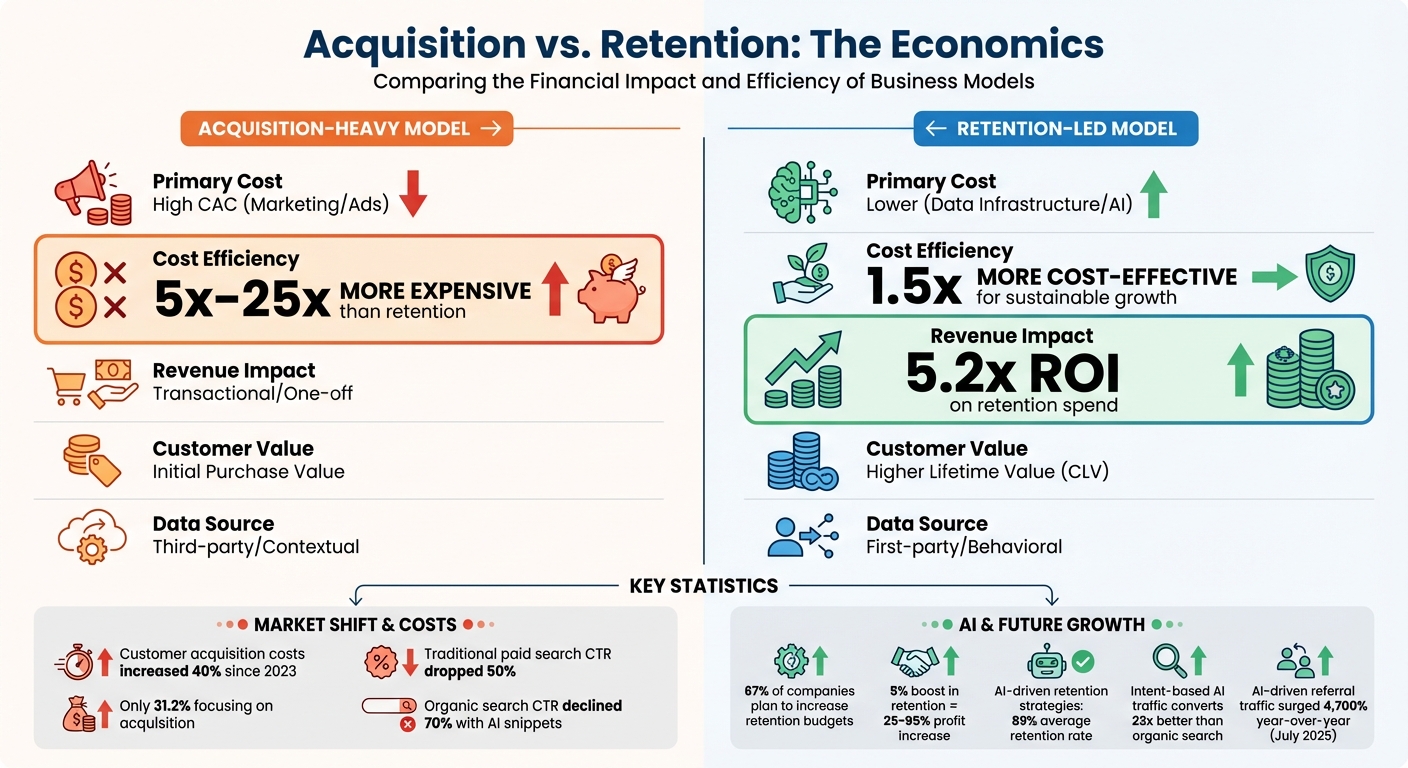
Acquisition vs. Retention: The Economics
The cost difference between acquiring and retaining customers is staggering. Bringing in a new customer can be 5 to 25 times more expensive than keeping an existing one [16]. Meanwhile, AI-driven referral traffic to retail sites surged by 4,700% year-over-year as of July 2025 [19]. In contrast, traditional paid search click-through rates have dropped by 50%, and organic search CTR has declined by 70% when AI-generated snippets dominate search results [18].
| Metric | Acquisition-Heavy Model | Retention-Led Model |
|---|---|---|
| Primary Cost | High CAC (Marketing/Ads) | Lower (Data Infrastructure/AI) |
| Cost Efficiency | 5x–25x more expensive [16] | 1.5x more cost-effective [15] |
| Revenue Impact | Transactional/One-off | 5.2x ROI on retention spend [13] |
| Customer Value | Initial Purchase Value | Higher Lifetime Value (CLV) [16] |
| Data Source | Third-party/Contextual | First-party/Behavioral [15] |
AI-driven strategies also deliver higher conversion rates, with intent-based AI traffic converting 23 times better than traditional organic search traffic [18]. As AI continues to shape how customers discover and engage with brands, the key to growth lies in maximizing the lifetime value of your existing customers – not just chasing more traffic.
Conclusion: Owning Customer Relationships in the AI Era
The rise of AI platforms like GPT is reshaping not just how customers find products, but also who holds the reins in that process. With AI agents now acting as the primary gatekeepers between consumers and brands, companies face a tough decision: either battle for visibility within AI-generated results or focus on building direct relationships that reduce reliance on intermediaries. This shift places a premium on cultivating stronger, more direct customer connections.
The surge in AI-driven traffic has upended traditional discovery methods. Shockingly, up to 70% of brands selling online have no presence on generative AI platforms, and only 10–15% of traffic from these platforms actually converts into visits to e-commerce sites [3]. This trend has effectively shortened the customer journey, compressing what used to be multi-step processes into single, AI-powered interactions.
To thrive in this new environment, first-party data and retention strategies are no longer optional – they’re essential. AI agents prioritize practical factors like price, delivery speed, and real-time inventory over brand recognition [17][19]. This means brands must use their data to anticipate needs and create personalized, timely interactions. Replenit serves as a prime example, leveraging first-party data to automate and predict customer lifecycle events. By knowing when customers will need a product and delivering the right message at the right moment, brands can reduce dependence on competitive AI auctions and maximize long-term customer value.
Stanislas Vignon, Head of Insights (AI and Omnichannel) at Louis Vuitton Moët Hennessy, captures this shift perfectly:
“Our creativity and authentic brand promise are what make us unique. AI cannot do that for us. What it will do is help us amplify our values and what differentiates us from others.”
- Stanislas Vignon [7]
In an era where AI platforms dominate discovery, success will belong to brands that take ownership of their customer relationships. The real question isn’t whether you should shift your focus from acquisition to retention – it’s whether you’ll make that move before your competitors do.
FAQs
How are AI tools like ChatGPT changing the way people search for products?
AI tools like ChatGPT are changing how people find products, moving the focus from traditional search engines and online marketplaces to conversational AI assistants. Instead of typing keywords into a search bar, users can now ask specific questions, receive tailored product recommendations, and even complete purchases – all within a chat.
This evolution means that product discovery is increasingly shaped by AI-driven responses rather than traditional search engine results pages (SERPs). These AI assistants are also stepping in earlier in the shopping process, capturing consumer interest before they even reach brand websites or marketplaces. For brands, this shift requires a new approach: optimizing product data and crafting messaging that ensures visibility within AI-driven platforms. It’s quickly becoming a key strategy for staying relevant in this changing search landscape.
Why is focusing on customer retention more cost-effective than acquiring new customers in an AI-driven market?
Focusing on keeping your current customers happy is often much cheaper than trying to win over new ones. In today’s AI-powered world, tools like large language models (LLMs) allow brands to tap into their own customer data to deliver highly tailored and proactive experiences. This approach not only helps reduce customer turnover but also strengthens loyalty and increases how much customers spend over time.
When businesses make retention a priority, they can build steady revenue streams and get the most out of their existing customer base. Plus, with the rising costs and competition of paid customer acquisition, having strong, lasting relationships with your customers gives your business a real edge in driving consistent growth.
Why is first-party data so important for improving customer retention?
First-party data plays a crucial role in keeping customers engaged because it offers direct, trustworthy insights into their preferences, behaviors, and interactions with your brand. With privacy regulations becoming stricter and third-party data harder to access, first-party data allows retailers to craft personalized experiences that encourage loyalty and keep churn rates low.
By diving into this data, brands can anticipate customer needs, pinpoint high-value segments, and deliver customized marketing efforts – like timely replenishment reminders or relevant cross-sell suggestions. This strategy doesn’t just boost repeat purchases; it also shifts the emphasis from costly customer acquisition to strengthening bonds with your current audience. As AI continues to shape the future, tapping into first-party data becomes a major advantage for ensuring steady, reliable growth.