

AI Transformation Mistakes in Retail
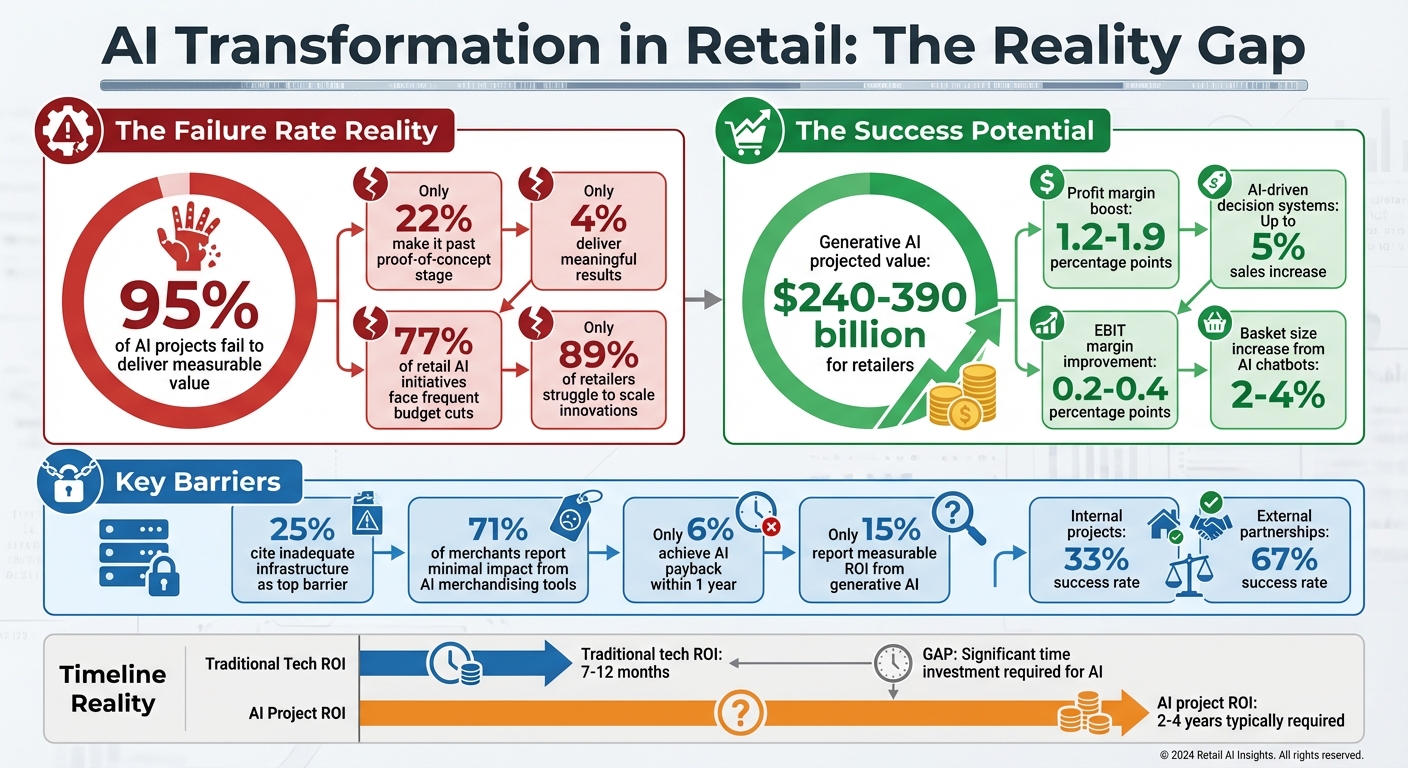
Retailers are investing heavily in AI, but 95% of AI projects fail to deliver measurable value. Only 4% of companies see meaningful results, often due to avoidable mistakes like poor implementation, outdated processes, and misaligned goals. While AI promises significant benefits – like boosting profit margins by 1.2 to 1.9 percentage points – most efforts fall short because businesses treat AI as a tool rather than a revenue-driving system.
Key takeaways:
- Common pitfalls: Relying on predictions without action, applying AI to flawed processes, and failing to scale pilot projects.
- Data issues: Poor quality and fragmented systems undermine AI’s potential.
- Missed metrics: Many focus on activity instead of revenue impact.
- Solutions: Align AI with clear business objectives, prioritize decision intelligence over analytics, and integrate AI into existing systems.
To succeed, retailers must focus on real-time, revenue-focused actions and ensure AI is embedded into decision-making processes. Avoiding these mistakes can turn AI into a consistent driver of growth.
AI Hype vs Reality in Retail
What AI Vendors Promise Retailers
AI vendors paint an enticing picture for retailers. They promise personalized customer experiences that foster loyalty, inventory management systems that eliminate stock issues, and automated revenue growth tools that pinpoint upsell and cross-sell opportunities. These solutions are marketed as transformative, with claims of precise demand predictions and uncovering hidden revenue streams. Generative AI alone is projected to contribute between $240 billion and $390 billion in economic value for retailers, potentially boosting profit margins by 1.2 to 1.9 percentage points.
The sales pitch often highlights AI as a plug-and-play solution: implement the model, feed it data, and watch the magic happen. Vendors emphasize quick results, seamless integration, and minimal disruption to existing systems. The underlying message? AI can solve significant challenges without requiring businesses to overhaul their operations. However, when these promises meet the realities of implementation, the results often fall short.
Why Most AI Projects Fail
The reality of AI execution in retail tells a much different story. A staggering 95% of enterprise AI initiatives fail to impact profit and loss. Only 22% make it past the proof-of-concept stage, and a mere 4% deliver meaningful results, revealing a clear gap between expectations and outcomes.
The issue isn’t the technology itself – it works. Instead, failures stem from deployment challenges, as Bain & Company explains. Many retail AI projects falter due to organizational dysfunction, including outdated infrastructure, inconsistent funding, and resistance to changing entrenched workflows. For example, 77% of retail AI initiatives face frequent budget cuts, often because they don’t produce immediate results. Additionally, 89% of retailers admit they struggle to scale innovations across their organizations.
This creates a frustrating cycle: executives approve AI projects with high hopes for quick wins, only to pull funding when results fail to materialize within a few quarters. As one executive from a Telecommunications, Media & Technology Company put it:
“Everyone is asking their organization to adopt AI, even if they don’t know what the output is. There is so much hype that I think companies are expecting it to just magically solve everything”.
Another common pitfall is the “pilot trap.” Retailers often invest heavily in advanced AI applications without first addressing data silos, poor data quality, and infrastructure gaps. When foundational issues are ignored, the models inevitably underperform, leaving businesses wondering why the promised results never materialize. Recognizing these recurring mistakes is essential for leveraging data and advanced decision-making tools to achieve real revenue growth.
Common Failure Points in Retail AI Projects
Understanding why AI projects fail is crucial for retailers looking to avoid costly mistakes. Interestingly, these failures often have little to do with the technology itself. Instead, they usually stem from how the technology is applied – or misapplied – leading to missed revenue opportunities.
Using AI for Predictions Instead of Decisions
Many retail AI tools focus on forecasts, but these predictions often require manual follow-up. For instance, a dashboard might show a merchant the expected demand for the next quarter. However, the merchant still has to manually adjust orders, tweak pricing, and align with suppliers. This reliance on manual intervention keeps businesses stuck in a reactive loop rather than enabling automated, proactive decision-making.
Here’s a telling statistic: 71% of retail merchants report minimal impact from AI merchandising tools. The issue isn’t that the predictions are inaccurate. The problem is that predictions alone don’t drive action or results. A forecast sitting idly in a dashboard doesn’t generate revenue – it’s the leap from prediction to automated response where value is often lost.
Moreover, when AI is layered on top of flawed processes, its potential impact diminishes significantly.
Adding AI to Broken Processes
AI often exposes deeper organizational issues rather than solving them. If retailers try to implement AI without addressing fragmented data systems or inconsistent workflows, they risk amplifying existing problems. Bain & Company highlights this issue, noting that pilot projects often succeed because they rely on manually cleaned, offline datasets. But when it’s time to scale, unresolved data issues resurface and derail progress.
Consider this: 25% of executives identify inadequate infrastructure and poor data quality as the top barriers to achieving AI ROI. The principle of “garbage in, garbage out” is as relevant as ever. AI systems depend on clean, reliable data. Without it, they act on flawed inputs, leading to subpar performance and eroded trust. For example, one organization unified its data governance, which improved efficiency by 20–25% and recovered $10 million from billing errors.
The takeaway? AI won’t fix broken processes. Retailers need to address these foundational issues before introducing advanced technology.
Running Pilots That Never Scale
Another common pitfall is investing in proof-of-concept projects that show promise in controlled settings but fail to scale. Only 22% of companies advance beyond the pilot stage, and just 4% see meaningful value creation.
This isn’t a technical issue – it’s an organizational one. Many retailers approach AI as a series of experiments rather than a transformative shift in operations. Interestingly, internal AI projects succeed only 33% of the time, compared to a 67% success rate for projects developed with external partners. The difference often lies in accountability and the ability to transition from testing to execution.
Budget constraints add to the challenge. While most technology investments aim for payback within 7 to 12 months, AI initiatives typically require 2 to 4 years to deliver satisfactory ROI. This mismatch in timelines leads to frustration, with 77% of retailers frequently cutting budgets for innovation projects when results don’t come quickly enough. To scale successfully, retailers need clear, revenue-focused goals from the outset.
Measuring Activity Instead of Revenue
Retailers also stumble by tracking the wrong metrics. Many measure AI success using operational benchmarks – like model accuracy, data processing speed, or dashboard usage – rather than focusing on business outcomes such as increased revenue or improved customer lifetime value. This misalignment creates a gap between what the AI team celebrates and what actually matters to the company’s bottom line.
When poorly integrated, AI tools often drive teams back to outdated methods like spreadsheets, negating potential efficiency gains. Even if the technology works as intended, it becomes just another expense if it doesn’t translate to measurable revenue. Only 6% of organizations report achieving AI payback within a year, largely because they prioritize the wrong metrics from the beginning.
To avoid this, retailers need to define clear business objectives before building AI models. What specific revenue-driving actions should the AI enable? How will the impact be measured? Without clear answers, even the most advanced systems can fail to deliver meaningful returns.
These recurring issues highlight why simply adding more data or building better models isn’t enough to guarantee success – or revenue.
Why More Data and Models Don’t Guarantee Revenue
Retailers often believe that having more data and advanced models will naturally lead to increased business value. Unfortunately, this assumption doesn’t hold up. In fact, 95% of AI initiatives fail to progress beyond the pilot stage. The real issue isn’t a lack of data or overly simple models – it’s about effectively managing that data and ensuring models are tied to goals that directly impact revenue.
Unlike traditional tech investments, which typically pay off in 7–12 months, AI projects often take 2–4 years to deliver returns. Only 6% of AI projects achieve payback in under a year. This disconnect stems from prioritizing data volume and model complexity over data quality and alignment with business objectives. The two main challenges? Data quality problems and models that don’t align with business goals.
Data Silos and Quality Issues
Even with mountains of data, its value diminishes when it’s trapped in silos or riddled with quality issues. The principle here is simple: garbage in, garbage out. As Bain & Company puts it, “The basic rule of ‘garbage in, garbage out’ remains a feature of AI as much as any other digital solution”. Advanced models can only perform as well as the data they’re fed. Many AI pilots thrive in controlled environments with manually cleaned datasets but falter in production when real-world data problems resurface.
Data silos create fragmented views – what Bain calls “multiple versions of truth” – making it nearly impossible to generate the cross-functional insights needed to drive revenue. For example, if marketing and finance define a “repeat customer” differently, AI recommendations may clash. Without a unified data source, AI-driven decisions can lead to poor execution. A case in point: one company improved efficiency by 20–25% and recovered $10 million in billing errors simply by unifying data governance.
When data governance is weak, it not only skews model outputs but also undermines revenue-focused actions, creating a ripple effect of misaligned objectives.
Models Without Business Objectives
Equally problematic is the failure to align AI models with clear business goals. Too often, AI models are treated as isolated technical experiments rather than tools integrated into core systems with defined revenue targets. Retailers frequently launch AI initiatives without connecting them to essential platforms like ERP or CRM systems or linking them to profit-driving use cases such as inventory accuracy or fulfillment speed. As a result, even the most advanced models fail to deliver measurable value.
Consider the potential of generative AI, which could unlock $240–$390 billion in value. Yet, only 2 out of 52 Fortune 500 retail executives have fully implemented it. The problem isn’t the technology itself – it’s how these models are deployed and whether they’re tied to tangible business objectives.
AI success depends less on the sophistication of algorithms and more on redesigning processes and involving the right people – efforts that account for about 70% of the work. As Incisiv explains, “AI pilots collapse because organizations treat them as experiments in isolation rather than transformations of how the business runs”. Without clear ownership, defined revenue goals, and integration into day-to-day decision-making, even the best models risk becoming expensive experiments instead of tools for growth.
Automation vs Analytics vs Decision Intelligence
Understanding the distinct roles of automation, analytics, and decision intelligence is key to turning data into revenue. However, many retailers mistakenly group these concepts together. Rules-based automation handles repetitive tasks using fixed logic, like generating product images or auditing contracts. Predictive analytics identifies patterns and forecasts outcomes but often stops short of taking action. Decision intelligence goes a step further by navigating complex trade-offs and executing revenue-driving decisions in real time without human intervention.
This misunderstanding can be costly. Retailers often invest in analytics dashboards that highlight declining performance but then spend weeks debating what to do next. Meanwhile, competitors using decision intelligence can quickly adjust pricing or reallocate inventory. As Boston Consulting Group (BCG) puts it:
“AI-first retailers aren’t just automating tasks; they’re orchestrating decisions”.
Here’s a closer look at how these approaches differ and why decision intelligence is essential for converting insights into immediate actions.
Rules-Based Automation
Traditional automation relies on fixed if-then rules to handle repetitive tasks. For example, Amazon introduced an AI-powered tool that transforms basic product photos into lifestyle images using text prompts, boosting advertising click-through rates by 40%. Similarly, Mercado Libre implemented generative AI copilots, cutting repetitive software engineering tasks by up to 60%. While these tools save time and reduce costs, they can’t adapt to changing conditions or decide what features to prioritize.
Predictive Analytics Without Action
Predictive analytics excels at identifying problems, like a drop in foot traffic or declining repurchase rates among certain customers. The challenge lies in translating these insights into action. Often, organizations delay decisions, missing opportunities to address issues promptly.
Take Swedish retailer Lindex, for example. They launched “Lindex Copilot”, an AI tool that offers employees personalized guidance for daily tasks. Despite such efforts, only 15% of organizations using generative AI report achieving measurable ROI. This is largely because many implementations stop at generating insights without linking them to immediate revenue-driving actions.
Decision Intelligence for Revenue
Decision intelligence stands out by connecting insights to real-time actions. It evaluates variables like inventory levels, customer lifetime value, margins, and churn risk, then automatically executes the best course of action. For instance, Walmart uses AI to autonomously negotiate with smaller vendors, removing the need for manual involvement.
This capability is more than just a time-saver – it directly impacts revenue. Gen-AI-powered decision-making systems are expected to drive up to a 5% increase in sales and improve EBIT margins by 0.2 to 0.4 percentage points. Unlike analytics tools that merely identify at-risk customers, decision intelligence systems can proactively offer retention incentives, adjust inventory replenishment schedules, or recommend alternative products.
However, only 10% of organizations using agentic AI report significant ROI. Achieving success requires more than just layering decision intelligence on top of existing systems. It involves redesigning processes and integrating AI into core platforms like ERP and CRM systems.
Retailers that effectively implement decision intelligence treat it as a central decision-making layer. This layer orchestrates actions across the customer lifecycle, from optimizing replenishment schedules to preventing churn and offering dynamic product substitutions. By shifting from insight generation to action execution, decision intelligence transforms AI into a continuous revenue generator that learns and improves over time with minimal human input. This approach represents a fundamental shift in how AI can directly drive retail success.
How High-ROI Retail AI Actually Works
High-ROI retail AI goes beyond just crunching numbers or automating tasks – it drives smarter decisions throughout the customer journey. It stands apart by adhering to three key principles: learning continuously from real-time customer behavior, delivering measurable revenue outcomes, and seamlessly integrating with existing retail systems. Many retailers stumble because they treat AI as a standalone tool rather than embedding it into their decision-making processes. By addressing these common pitfalls, high-ROI AI transforms raw data into tangible revenue gains. Let’s dive into how continuous learning and real-time decision-making make this possible.
Continuous Learning and Real-Time Actions
The secret to effective AI lies in its ability to act as an intelligent agent – managing complex, multi-step operations with minimal human intervention. Unlike traditional automation, which relies on rigid rules, these systems adapt dynamically to customer behavior. Forget waiting for weekly or monthly reviews; high-ROI AI evaluates factors like purchase trends, inventory levels, profit margins, and churn risks in real time, automatically taking the best next step.
Take Walmart, for example. Their AI agents autonomously negotiate with smaller vendors, cutting out the need for manual approvals. This doesn’t mean replacing human expertise – it means delegating routine tasks so teams can focus on strategic priorities. The AI learns from every transaction, improving over time based on outcomes rather than sticking to static guidelines. As one financial services executive put it:
“Moving to an agentic platform is a true game changer … but it requires seamless interaction with the entire ecosystem, including data, tools and business processes”.
This ability to adapt continuously lays the groundwork for revenue-focused results.
Revenue-Centric Outcomes
Retailers achieving real success with AI don’t just track activity metrics – they measure outcomes directly tied to revenue. For instance, AI-driven decision systems can boost sales by as much as 5% and improve EBIT margins by 0.2 to 0.4 percentage points. Even more telling, 49% of AI ROI Leaders report their biggest wins as “creating revenue growth opportunities” rather than simply cutting costs. Metrics like repeat purchase rates, customer lifetime value (CLTV), and post-purchase revenue are prioritized because they directly impact the bottom line.
Amazon provided a striking example in late 2023 with its AI-powered image generation tool. By transforming standard product photos into lifestyle images using text prompts, the company saw a 40% increase in advertising click-through rates. The goal wasn’t just to produce more visuals – it was to drive conversions. Similarly, AI-powered chatbots delivering personalized recommendations have shown to increase basket sizes by 2% to 4%, often covering implementation costs on their own. These systems turn customer behavior data into actionable strategies like replenishment reminders, cross-sell suggestions, churn prevention offers, and product substitutions. But for AI to deliver these results, it must work seamlessly with the tools retailers already have.
Working With Existing Systems
High-ROI AI doesn’t require retailers to rip out their current tech stacks. Instead, it acts as a decision layer, complementing existing customer data platforms (CDPs), data warehouses, and marketing automation tools. This approach – sometimes called a “shaper” model – allows retailers to combine off-the-shelf AI models with their proprietary data and code, delivering tailored results without expensive overhauls. The key is interoperability, ensuring smooth data exchange while avoiding new silos.
Platforms like Replenit illustrate this perfectly. They integrate directly with existing systems, pulling behavioral data and feeding back automated revenue-driving actions through established channels. This means retailers can focus on outcomes like higher repeat purchase rates, CLTV growth, and increased post-purchase revenue. What’s more, ROI often becomes visible within weeks, unlike the years-long timelines typical of many AI projects. The modular nature of this setup also allows for flexibility – retailers can switch between AI models as technology advances without disrupting their business logic or locking themselves into a single vendor.
What Successful Retailers Do Differently
The real difference in AI success for retailers isn’t just about having the right technology – it’s about executing a well-aligned strategy. While some efforts falter, successful retailers stand out by ensuring their strategy and operations work hand in hand. They focus on laying a strong operational foundation, embedding AI into essential workflows, and tracking measurable outcomes that directly improve profitability. These efforts not only enhance margins but also unlock meaningful economic value, paving the way for AI to become an integral part of their critical processes.
Building the Right Foundation First
Top-performing retailers don’t dive into AI projects without preparation – they start by establishing a solid operational base. This includes prioritizing governance, ensuring high-quality data, and setting clear KPIs well before any coding begins. Governance, in this context, isn’t about creating unnecessary red tape. As Incisiv points out:
“Strong governance is not bureaucracy – it’s the operating system that keeps AI tied to strategy”.
For these retailers, data isn’t just stored – it’s treated as a strategic resource. Instead of dumping everything into massive, unstructured “data lakes”, they create reusable, high-quality data products tailored for specific business needs. These curated datasets are easy for teams across the organization to find and use, ensuring data serves a clear purpose. By focusing on specific areas like supply chain optimization or customer experience, they avoid spreading their resources too thin across unrelated projects.
Another standout trait is how they manage their AI budgets. Leaders in AI-driven ROI allocate over 10% of their total tech budgets to AI initiatives and ensure funding is tied to clear adoption and ROI milestones. Collaboration also plays a big role: AI projects involving external partners succeed 67% of the time, compared to a 33% success rate for purely in-house efforts.
Converting Behavioral Data Into Revenue Actions
Successful retailers don’t stop at generating insights – they automate actions that drive revenue. Instead of relying solely on dashboards or predictions, they use AI to orchestrate decisions. This enables automated processes like adjusting stock allocations, tailoring assortments to specific locations, and triggering real-time restocking actions. For instance, rather than just identifying which customers are likely to churn, their systems can automatically send personalized retention offers at the perfect moment.
Platforms like Replenit demonstrate this approach in action. Replenit doesn’t require replacing existing systems like customer data platforms or marketing automation tools. Instead, it acts as a decision layer, aggregating behavioral data – such as purchase history, browsing habits, and product usage trends – and converting it into automated actions. These actions include replenishment reminders, cross-sell opportunities, churn prevention campaigns, and product substitution suggestions. By integrating seamlessly with existing systems, solutions like Replenit deliver value faster than traditional AI initiatives.
The takeaway? AI’s value doesn’t exist in a vacuum. Its real impact comes when it’s woven into broader efforts to improve data quality, streamline operations, and encourage collaboration across teams. This integration is what drives meaningful results.
AI Evaluation Checklist for Retailers
Building on the earlier principles of revenue-driven AI, this checklist serves as a practical guide for evaluating your readiness to implement AI and for tracking its financial impact. The success of any AI initiative hinges on asking the right questions and focusing on metrics that tie directly to revenue.
Questions to Assess AI Readiness
- Establish clear accountability: Ensure the AI initiative is tied to business outcomes, not just technology. Without strong accountability, AI projects risk straying from their impact on the profit and loss statement.
- Evaluate your data architecture: Can it handle unstructured inputs like audio, video, or images in real time? Many pilots rely on manually cleaned offline data, but production systems need to scale and operate in real time.
- Check system integration: Confirm the AI solution works seamlessly with your existing ERP, CRM, and data platforms to speed up value delivery.
- Broaden your metrics: Look beyond financial ROI. Include measures like employee satisfaction and vendor relationships to capture the broader impact. AI tends to deliver better results when paired with efforts to improve data quality, restructure teams, and streamline operations.
- Avoid vendor lock-in: Opt for solutions with modular architecture. This flexibility allows you to switch models or providers without overhauling your entire system.
- Prepare your workforce: Develop training programs for non-technical staff to interact effectively with AI and use prompt engineering.
Tracking Revenue Metrics
Once your AI initiative is ready, shift your focus to measuring its direct impact on revenue. Replace activity-based metrics with indicators that directly affect your profit and loss. Key revenue-related metrics include:
- Repeat purchase rate
- Customer lifetime value uplift
- Purchase frequency
For instance, a modest 2% to 4% increase in basket size can offset the operational costs of tools powered by large language models (LLMs). Meanwhile, AI-driven decision-making systems can deliver up to 5% in incremental sales and improve EBIT margins by 0.2 to 0.4 percentage points.
Create a “Performance Index” to track key outcomes such as financial return, revenue growth from AI, operational cost savings, and the speed of achieving results. Remember, different types of AI require distinct evaluation methods. Generative AI often shows results in productivity and efficiency gains within a year, while agentic AI focuses on long-term process redesign and cost savings, typically over three to five years.
Other metrics to monitor include inventory accuracy, fulfillment speed, multi-channel shopper order values, and retention rates. Given that only 15% of organizations currently report significant ROI from generative AI, it’s crucial to set realistic expectations. Most initiatives take two to four years to yield satisfactory results, so patience and planning are key to avoiding premature project termination.
This checklist underscores the importance of aligning AI investments with outcomes that directly drive revenue, ensuring that every initiative contributes meaningfully to your business goals.
Conclusion
Achieving success with AI in retail isn’t about having the most sophisticated algorithms or the largest datasets. Instead, it hinges on avoiding critical missteps that often derail enterprise AI projects. These include treating AI as a tech experiment instead of a business transformation, applying AI to broken processes, and focusing on activity metrics instead of measurable revenue outcomes.
“Success with AI requires building adaptive organizations, not just smarter algorithms.” – Miloni Thakker, Incisiv
Retailers seeing real results from AI – those anticipating 60% more revenue growth than their competitors – share a few key strategies. They implement clear governance structures, tying funding to measurable outcomes at every stage. Their focus is on initiatives with direct P&L impact, such as improving inventory accuracy or increasing customer lifetime value (CLTV). Most importantly, they design their AI systems to scale from the start, treating AI as an autonomous decision-making layer that drives revenue without constant human intervention.
The earlier checklist provides a practical way to evaluate whether your AI initiative is set up to deliver revenue growth or risk stalling. Pay attention to metrics like repeat purchase rates, CLTV growth, and purchase frequency. Ensure your AI solution integrates smoothly with your existing systems and operates in real time, avoiding reliance on manually processed offline data.
Ultimately, true transformation comes from a commitment to revenue-focused outcomes. Before investing in AI, ask yourself: Does this solution automate revenue generation, or does it just add unnecessary complexity?
FAQs
What are the biggest mistakes retailers make when adopting AI?
Retailers often stumble when adopting AI because they see it as just another tool rather than a dynamic decision-making system. One major misstep is layering AI on top of outdated workflows or rigid rules, which severely limits its potential. Instead of leveraging AI to create automated, revenue-driving actions, many focus too heavily on dashboards and predictions that don’t directly impact business outcomes.
Another common mistake? Measuring success with activity-based metrics like completing a pilot program, rather than focusing on results that matter – like incremental revenue growth or customer lifetime value (CLTV). On top of that, the challenges of integrating AI into existing systems are often underestimated, causing projects to stall or deliver lackluster results. For AI to truly make an impact, it needs to align with specific business goals and deliver outcomes that can be clearly measured.
How can retailers ensure their AI initiatives drive real revenue growth?
Retailers looking to drive measurable revenue growth with AI need to focus on aligning AI efforts with specific business goals. The emphasis should be on achieving outcomes like boosting repeat purchases, improving customer retention, and increasing customer lifetime value. For AI to truly make an impact, it must go beyond simply offering predictions or dashboards. Instead, it should power real-time, automated actions that directly influence revenue – think post-purchase strategies, effective cross-selling, or preventing customer churn.
The most successful retailers steer clear of common mistakes, such as treating AI as an isolated tool or running pilots that never scale up. They make AI an integral part of their decision-making processes, ensuring it works smoothly with their existing systems. The focus remains on delivering incremental revenue gains. Measuring success through concrete results, like an increase in repeat revenue or lifetime value, ensures that AI investments translate into meaningful financial returns.
Why do many AI initiatives in retail fail to scale beyond the pilot phase?
Many AI projects in the retail sector hit a wall after the pilot stage, and the reasons often go beyond technical hurdles. The real stumbling blocks tend to be organizational and process-related. Outdated workflows, unclear data ownership, and resistance to change within the company are some of the most common barriers. Without tackling these core issues, AI systems are unlikely to provide business results that truly matter.
Another major roadblock is the tendency to focus on pilots or dashboards rather than scaling AI into automated systems that drive revenue. When AI projects are layered over inefficient processes or rigid rules, they often fail to deliver measurable outcomes, such as boosting repeat revenue or increasing customer lifetime value. To make AI work, it needs to be embedded into everyday operations, prioritizing real-time actions and incremental revenue gains over vanity metrics or static reports.