

AI in Retail 101: From AI Transformation to Commercial Impact
AI is no longer a futuristic concept in retail – it’s here, but many retailers are struggling to make it count. Despite widespread adoption of tools like chatbots and predictive dashboards, the real challenge lies in turning AI into a revenue-driving force. Here’s what you need to know:
- Why AI projects fail: Most retailers focus on flashy tools rather than systems that autonomously drive revenue. Fragmented data and superficial implementations leave opportunities untapped.
- What works: AI decision engines are transforming retail by automating complex decisions like pricing, inventory, and customer engagement. These systems act autonomously, optimize in real-time, and directly impact financial outcomes.
- The evolution of AI: Retailers are moving from basic automation (repetitive tasks) and prediction (forecasting outcomes) to reasoning (goal-driven decisions) and decisioning (autonomous execution).
- The payoff: Companies using advanced AI report benefits like a 20–30% reduction in inventory costs, 85% better product availability, and up to 4% revenue growth.
Retailers must stop treating AI as an add-on and start embedding it into core operations. The future belongs to those who use AI to automate decisions, improve efficiency, and drive revenue growth.
What AI Transformation in Retail Actually Means
AI transformation in retail goes far beyond just implementing chatbots or creating dashboards. It’s about integrating intelligence directly into the operations that generate revenue. This shift moves retailers from relying on tools that need constant monitoring to systems capable of reasoning, making decisions, and taking action autonomously throughout the customer lifecycle.
Currently, many retailers use AI in a limited way – a recommendation engine here, a predictive report there. True transformation happens when AI acts as the decision-making hub that connects and coordinates merchandising, marketing, and supply chain activities in real time. Instead of isolated tools waiting for someone to interpret data and act, these systems analyze context, weigh limitations, and make decisions within strategic guidelines established by the business.
This approach enables personalized decision-making at scale. Instead of grouping customers into broad categories, AI can tailor actions based on real-time behaviors, past purchases, and lifecycle signals. It’s a shift from “send this email to everyone who bought something in the last 30 days” to “determine the next best action for each customer instantly, based on their unique interactions and preferences.”
The potential impact is clear. 48% of retail respondents plan to adopt agentic AI by 2026, and 30% of global digital commerce is projected to be influenced by agentic AI by 2030. These aren’t small-scale experiments – they’re operational systems managing tasks like pricing adjustments, inventory distribution, and customer lifecycle triggers, all without requiring manual input for every decision. This evolution lays the groundwork for understanding how operational intelligence comes to life.
Operational Intelligence vs. Basic Automation
To grasp the power of autonomous systems, it’s important to distinguish between basic automation and operational intelligence. The key difference lies in reasoning versus static rules. Basic automation operates on fixed logic: if a customer does X, trigger Y. Operational intelligence, on the other hand, evaluates multiple signals, considers the broader context, and chooses the best course of action based on defined goals.
For example, traditional workflows might automatically send a replenishment email 30 days after a purchase. Intelligent systems, however, analyze factors like the customer’s consumption habits, the type of product, purchase history, and current engagement level. They then decide whether to send a message, what it should say, when to send it, and which channel to use.
“Traditional AI is like a vending machine. It waits for input, follows a script, and delivers a predetermined output. Agentic AI is like an experienced store manager.”
What sets intelligent systems apart is their ability to close the decision loop. They don’t just execute actions – they also track results and refine future decisions based on what they learn. This continuous improvement is what differentiates AI that evolves over time from automation that remains locked in outdated logic.
Retailers who treat AI as just another add-on feature will see only modest improvements. But those who reimagine their operations around intelligent, autonomous decision-making will gain the agility, precision, and impact that static systems simply cannot achieve.
Why Most AI Projects in Retail Fail to Create Revenue Impact
Many AI projects in retail fall short because they focus on flashy tools rather than systems designed to autonomously drive revenue. Retailers often pour resources into chatbots, dashboards, and other surface-level features, expecting major transformations but only seeing marginal improvements. The core problem? These tools fail to bridge the gap between insight and action, leaving significant revenue opportunities untapped.
Take this staggering statistic: the retail industry loses an estimated $1.7 trillion annually due to inventory distortion, while $2 trillion in e-commerce sales are abandoned each year because of poor product discovery. These issues require systems capable of handling complex reasoning, balancing trade-offs, and acting in real time – without waiting for human intervention. The disconnect between visible features and actionable intelligence highlights why so many AI initiatives struggle to deliver meaningful results.
Another common pitfall is the “tool-switching trap.” Retailers frequently jump from one AI vendor to another, chasing solutions that promise breakthroughs. However, as Julian Krenge, Co-Founder and CPO at parcelLab, points out, constantly changing tools without fully implementing them keeps businesses stuck at square one. The real issue isn’t the AI model itself – it’s the lack of integrated data and infrastructure needed to make these tools truly effective. For AI to succeed, it must evolve from isolated tools into a comprehensive decision engine that seamlessly integrates with operational data.
Without real-time access to unified data – covering orders, inventory, customer behavior, and product relationships – even the most advanced AI systems are reduced to prediction engines that talk without acting. When lofty expectations clash with shallow execution, these projects are labeled failures, reinforcing the perception that AI is just overhyped.
The Problem with Chatbots, Dashboards, and Static Predictions
The reliance on superficial tools like chatbots and dashboards further illustrates the gap between insight and impactful action. Chatbots, for example, handle routine queries but fail to address deeper customer concerns. Imagine a customer asking, “Where is my order?” The bot might respond with a tracking link, but it misses the real question: Will my package arrive before an important event? Without the ability to understand context or intent, the bot’s response falls short.
Dashboards and predictive analytics face a similar issue. They’re great at showing what’s happening or forecasting what might happen, but they don’t close the loop. For instance, a dashboard might predict a surge in demand for next week. However, if acting on that forecast requires manual coordination across merchandising, marketing, and fulfillment teams, the opportunity could slip away before anyone takes action.
The real shift comes when AI moves beyond tools that simply inform to systems that act. Paul Tepfenhart, Global Director of Retail at Google, captures this perfectly:
“The question will no longer be, ‘Where can we apply AI to save money?’ but rather, ‘How do we deploy AI agents to drive the existential transformation required?'”
True transformation isn’t about adding another chatbot or dashboard. It’s about embedding intelligence directly into the operations that generate revenue, manage inventory, and keep customers coming back. The future of retail AI lies in decision engines that work autonomously across the customer lifecycle – not in tools that rely on humans to connect the dots.
The Difference Between Automation, Prediction, Reasoning, and Decisioning
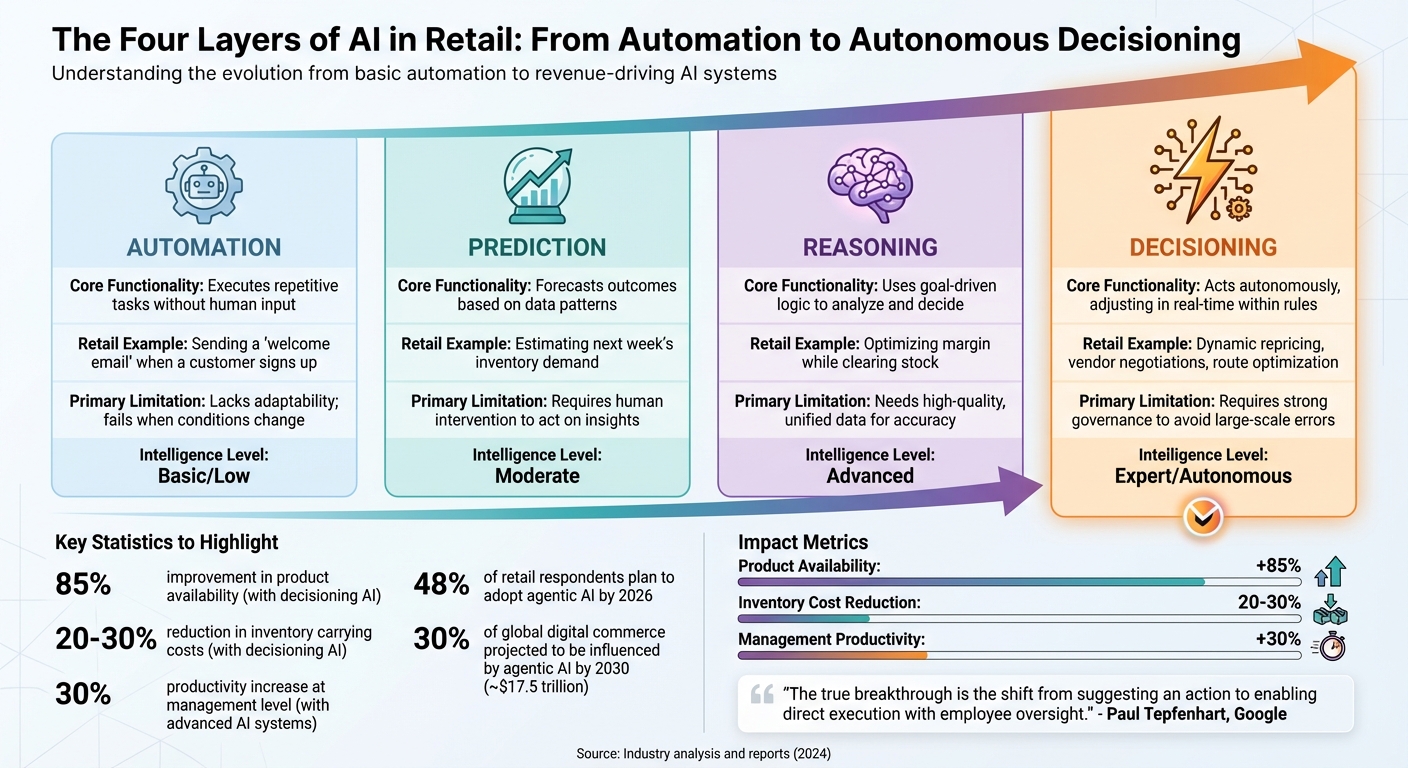
Retailers aiming to integrate intelligence into their operations must grasp the layers of AI, ranging from basic automation to advanced decision-making. These layers aren’t all created equal. The gap between systems that handle routine tasks and those that drive business impact lies in the level of intelligence involved. While many retailers stick to automation and prediction, the true potential lies in systems capable of reasoning and autonomous decision-making.
Automation is the simplest layer, taking care of repetitive tasks without human intervention. For instance, email triggers or inventory alerts follow predefined rules but lack deeper insight. Prediction takes it a step further by forecasting outcomes, like projecting next month’s demand or identifying customers at risk of churning. However, even here, humans must interpret the predictions and decide what actions to take next.
Reasoning represents a more advanced capability. Here, AI aligns with business goals and works backward to figure out the best course of action. For example, it might balance customer satisfaction with markdown losses or optimize an assortment mix while considering margins and inventory limits. This is a shift from asking, “What will happen?” to asking, “What should we do with the information we have?” Building on reasoning, decisioning takes things further by not only determining the best action but also executing it autonomously. This layer allows AI to act within set boundaries, learn from outcomes, and refine future decisions in real time.
Paul Tepfenhart, Global Director of Retail at Google, explains this evolution well:
“The true breakthrough is the shift from suggesting an action to enabling direct execution with employee oversight.”
Looking ahead, by 2030, agentic AI is expected to influence 30% of global digital commerce, equating to around $17.5 trillion. Even sooner, in 2026, 48% of retail respondents plan to implement decision-making AI. This marks a shift from passive tools that predict outcomes to active systems embedded across operations. In this emerging landscape, human roles evolve – focusing on defining strategic goals (“what” and “why”) while AI figures out the “how”.
Comparing AI Layers: From Automation to Decisioning
Here’s a quick breakdown of how each AI layer builds on the previous one to deliver operational intelligence:
| Layer | Core Functionality | Retail Use Case Example | Primary Limitation |
|---|---|---|---|
| Automation | Executes repetitive tasks without human input | Sending a “welcome email” when a customer signs up | Lacks adaptability; fails when conditions change |
| Prediction | Forecasts outcomes based on data patterns | Estimating next week’s inventory demand | Requires human intervention to act on insights |
| Reasoning | Uses goal-driven logic to analyze and decide | Optimizing margin while clearing stock | Needs high-quality, unified data for accuracy |
| Decisioning | Acts autonomously, adjusting in real time within rules | Dynamic repricing, vendor negotiations, route optimization | Requires strong governance to avoid large-scale errors |
Retailers adopting decisioning AI have reported an 85% boost in product availability and a 20–30% reduction in inventory carrying costs. Additionally, organizations with advanced AI systems see a 30% jump in productivity at the management level. These aren’t minor gains – they represent transformative changes in operational efficiency.
The transition from prediction to decisioning isn’t just a technical upgrade; it’s a strategic shift. It moves businesses from simply anticipating trends to building systems that act on them autonomously, continuously learn, and improve. This evolution turns AI into a true driver of revenue and operational excellence in retail.
Why AI Commercialization Matters More Than AI Experimentation
AI has been the subject of countless experiments – chatbots, dashboards, predictive models – but these efforts often fail to translate into revenue. The issue isn’t the technology itself; it’s how it’s utilized. AI commercialization marks a shift from “AI as experiment” to “AI in action” – where intelligent systems are integrated into core operations and directly impact financial outcomes.
Take retail, for example. Many companies have implemented sophisticated AI models but report limited financial gains. Why? Because the technology is often added superficially, rather than being deeply integrated into workflows. The real return on investment (ROI) depends less on the model’s technical capabilities and more on the infrastructure supporting it – things like data pipelines, integration into existing systems, and the authority given to AI in decision-making. To succeed, businesses must reimagine AI not as a separate tool but as a central operating layer that reshapes workflows. The goal isn’t just generating reports or predictions but empowering AI to make decisions that directly drive revenue, cut waste, and improve customer experiences. This is the key to turning isolated experiments into cohesive, revenue-generating systems.
From Pilots to Revenue-Generating Engines
To make this leap, businesses need to move beyond pilot projects and embrace AI as a revenue-driving force. This involves shifting from “human-controlled” models to “human-in-the-loop” systems. In this setup, AI takes charge of decisions like sending replenishment alerts, recommending cross-sell products, or determining whether a customer needs a discount or just a follow-up. Humans, meanwhile, focus on high-level strategy and handling exceptions.
The financial benefits of this approach are already clear. AI-enabled planning has been shown to boost revenue by up to 4% and cut inventory by 20%. Looking ahead, the concept of agentic commerce – AI-driven retail processes – is projected to create $3 to $5 trillion in global value by 2030. Furthermore, 76% of retailers plan to increase their investments in AI agents over the next year. These are not small-scale experiments; they are strategic investments in systems designed to operate, learn, and improve with minimal human intervention.
Retailers that treat AI as a decision-making engine, rather than a tool for generating insights or automating basic tasks, are the ones seeing real results. By embedding AI into processes like lifecycle management, inventory optimization, and customer engagement, they are moving from prediction to action, from insights to execution, and from pilots to profitability. This is the future of AI commercialization, and it’s already starting to take shape. Stay updated on the latest retail AI strategies and trends to stay ahead of the curve.
The Rise of AI Decision Engines in Retail
Retailers today have no shortage of tools – CRMs, CDPs, marketing automation platforms, and engagement systems are already in place. The real challenge isn’t technology itself but the lack of connected intelligence. Most of these systems rely on human input to function, which is where AI decision engines step in.
An AI decision engine isn’t just another tool in the tech stack. Think of it as the intelligence layer that works with existing systems, deciding the best action for each customer at the right moment. It functions as a self-improving loop, learning from past actions, analyzing outcomes, and refining future decisions. Unlike traditional CRM automations that follow static workflows, decision engines adapt to customer behavior, product trends, and lifecycle cues to make highly personalized decisions at scale.
This shift is already happening. By 2026, 48% of retail respondents plan to deploy agentic AI. These systems go beyond chatbots or copilots – they act autonomously, executing decisions with oversight rather than requiring initiation by employees. The financial benefits are clear: inventory distortion alone costs retailers $1.7 trillion annually, and AI decision engines can improve forecast accuracy by 35% to 42%. But the real advantage lies in their ability to turn insights into action, making thousands of micro-decisions every hour. Whether it’s pricing, replenishment, cross-sell, churn prevention, or promotional strategies, decision engines don’t just suggest – they execute. This positions AI as the smart overlay that converts operational data into meaningful, actionable outcomes.
AI as the Intelligence Layer Behind Execution
The future of retail isn’t about replacing existing systems but layering intelligence on top of them. Retailers often grapple with fragmented data and disconnected platforms, but adding yet another standalone tool isn’t the answer. Instead, AI decision engines enhance the efficiency and relevance of existing systems.
Take Replenit, for example. It’s an AI decision engine that integrates seamlessly with a retailer’s current tech stack. By analyzing customer behavior, purchase history, product relationships, and lifecycle signals, it identifies the next best action for each individual customer. Then, it triggers that action through the retailer’s existing systems and channels. Retailers don’t need to overhaul their infrastructure – they simply gain the intelligence layer they’ve been missing.
This approach transforms how human teams operate. Rather than spending time crafting endless workflows, updating segmentation rules, or manually deciding which customers receive which messages, teams can focus on setting strategic guardrails – the “what” and “why.” The AI takes care of the “how”, automating repetitive, low-value decisions. This frees up teams to concentrate on strategy, creative problem-solving, and other high-impact work.
The architecture of these systems is critical. As Impact Analytics highlights:
“The return on investment in Agentic AI is determined far less by model capability than by agentic decision intelligence made upstream”.
For AI to deliver results, it must connect to real-time data – shipping, order history, inventory, customer signals – and reason across merchandising, marketing, and supply chain operations to drive coherent actions. Julian Krenge, Co-Founder and CPO at parcelLab, underscores this point:
“What really keeps them stuck at stage zero is switching tools rather than enabling the tools… The limiting factor is how do you put in more knowledge, more context”.
Retailers that treat AI as a decision layer, rather than just another feature, are the ones achieving tangible results. They’re transitioning from “AI as experiment” to “AI in action” – embedding intelligent systems into their core operations and tying them directly to revenue, profit margins, and customer lifetime value. This marks the rise of AI decision engines, redefining how retail uses technology to turn operational intelligence into commercial success.
The Role of Synthetic Data Generation and Reasoning in Better Retail Decisions
Retailers often struggle with incomplete data. Catalogs might list product details but leave out crucial information like usage duration, frequency, or complementary items. Similarly, customer records might show purchase dates and amounts but fail to capture consumption habits, lifecycle stages, or intent. This is where synthetic data generation and reasoning step in to fill the gaps.
Synthetic data creates non-identifiable, statistically accurate datasets to compensate for missing information. It can also simulate rare scenarios, such as edge-case shopping behaviors, new product launches, or supply chain disruptions. Beyond filling gaps, synthetic data enables causal reasoning, allowing AI to simulate entire lifecycles and test “what-if” scenarios.
Take Replenit’s demonstration in early 2026 as an example. The platform analyzed a simple 30ml serum purchase record and, by synthesizing insights from 14 million reviews and studies, determined the product’s 45-day lifespan and its use in morning routines. This enriched understanding led to a 3.2x increase in conversion rates for targeted campaigns. The system didn’t just predict when a customer might buy again – it analyzed consumption patterns and lifecycle contexts to pinpoint the best time to act.
This combination of synthetic data and reasoning sets modern AI decision engines apart from traditional analytics. Rob Towes, a venture capitalist at Radical Ventures, aptly described the potential:
“Imagine if it were possible to produce infinite amounts of the world’s most valuable resource, cheaply and quickly… That is a reality today. It is called synthetic data”.
When paired with reasoning capabilities, synthetic data elevates AI from a pattern-matching tool to a decision-making system that understands the “why” behind customer behavior.
Making Better Decisions with Incomplete Data
Despite its promise, retail data in the real world remains fragmented. Sparse product catalogs, incomplete customer histories, and inconsistent behavioral signals make it tough for AI systems to deliver precise, revenue-driving insights. Synthetic reasoning steps in to bridge these gaps.
Retailers leveraging synthetic reasoning engines have seen data completeness jump from 23% to 94%, and prediction accuracy rise to 89% – a stark improvement over the 45% achieved with traditional data alone. By integrating external knowledge sources like reviews, scientific studies, and usage patterns, AI can generate the missing attributes necessary for better decision-making.
In January 2026, researchers presented findings at ICLR, demonstrating how AI models fine-tuned on “PhantomWiki” – a synthetic dataset containing fictional knowledge – outperformed others on real-world benchmarks like HotpotQA. These models gained a transferable skill called knowledge composition. As Anmol Kabra and colleagues explained:
“Knowledge composition is a transferable skill that can be learned in purely fictional worlds”.
By enabling AI to reason and simulate outcomes, synthetic data generation allows retailers to overcome incomplete datasets and make smarter decisions faster. This transforms AI from a reactive tool into a system that anticipates future needs, even with limited data.
The impact of these advancements is clear in the following metrics:
| Metric | Traditional Data Only | With Synthetic Data & Reasoning |
|---|---|---|
| Data Completeness | 23% | 94% |
| Prediction Accuracy | 45% | 89% |
| Actionable Insights | 12% | 78% |
| Manual Work Reduction | 0% | 80% |
Source: Replenit Data Enrichment Impact [14]
These numbers highlight how synthetic reasoning transforms AI into a proactive decision-making engine, capable of driving better outcomes across the retail landscape.
Why the Future of Retail is Agentic, Autonomous, and Individualized
The retail industry is undergoing a major transformation, shifting from predictive AI systems to agentic AI. Predictive AI helps forecast outcomes, leaving humans to act on those predictions. Agentic AI, on the other hand, takes it a step further by executing actions autonomously within set parameters. This isn’t just a small improvement – it’s a fundamental change. According to McKinsey, agentic commerce could generate between $3 trillion and $5 trillion in global value by 2030, while the broader agentic AI market is projected to reach nearly $196.6 billion by 2034.
This shift is essential given the pace and complexity of modern retail. Traditional planning cycles simply can’t keep up. Customers are increasingly relying on AI agents that understand context, constraints, and intent – going far beyond basic keyword searches. For example, AI can now help plan events like a toddler’s birthday party with remarkable precision. Meanwhile, outdated systems contribute to massive losses, with inventory distortion alone costing the industry trillions. Manual processes and static rules are no match for today’s demands.
Agentic systems operate through closed decision loops, which means they learn from past actions, evaluate outcomes, and adjust future decisions automatically. These systems work continuously, improving as they go. Paul Tepfenhart, Global Director of Retail at Google, highlights the significance of this shift:
“The question will no longer be, ‘Where can we apply AI to save money?’ but rather, ‘How do we deploy AI agents to drive the existential transformation required?'”
This transformation is also changing the role of retail employees. Instead of focusing on countless small decisions, teams now define strategic boundaries – the “what” and “why” – while AI takes care of the “how”. Far from replacing human workers, this approach allows people to focus on higher-value tasks like creating better customer experiences, strategic planning, and building relationships. Retailers adopting this model have already reported productivity gains of over 30% at the store level. This evolution is paving the way for AI systems that not only predict outcomes but also act on them, reshaping the retail landscape.
AI Agents for Precision Lifecycle Management
Agentic commerce relies on specialized AI agents designed to achieve specific goals. These agents work together across the entire customer lifecycle, responding to real-time data and executing actions using existing retail systems. Here’s how these agents are transforming key areas of retail operations:
| Agent Type | Primary Function | Commercial Impact |
|---|---|---|
| Replenishment Agent | Tracks demand and stock levels in real time, triggering orders or reallocating inventory as needed. | Cuts inventory carrying costs by 20–30%; improves availability by 85%. |
| Pricing Agent | Continuously adjusts prices based on competitor activity, inventory levels, and demand elasticity. | Boosts profits by up to 10%; speeds up inventory turnover by 30%. |
| Marketing Agent | Dynamically manages budgets across channels and updates creative based on inventory. | Increases campaign conversions by 20–30%; cuts acquisition costs by 50%. |
| Fulfillment Agent | Optimizes warehouse coordination to reduce split shipments and improve carrier efficiency. | Lowers last-mile costs by 25%; shortens delivery times by 20%. |
| Churn Prevention Agent | Uses first-party data to predict customer churn and deploys tailored retention strategies. | Enhances Customer Lifetime Value (CLTV) and reduces acquisition costs. |
These agents demonstrate how agentic systems connect strategic goals with operational execution. For example, in January 2026, Walmart introduced “Wally”, an assistant that helps merchants quickly analyze performance data and answer operational questions. Walmart also uses AI agents to negotiate with smaller vendors, eliminating manual procurement tasks. Target, in partnership with Bain and OpenAI, developed AI tools to assist with store operations and help merchandising teams better understand category performance before vendor negotiations. Amazon has created an AI-powered image generation tool that turns standard product photos into lifestyle images, increasing ad click-through rates by 40%.
The results speak for themselves. Retailers using agentic AI are already seeing tangible benefits, with 48% of retail respondents planning to implement these systems by 2026. Companies that embrace this technology will set the standard for the next decade, while those that hesitate will struggle to keep up with the speed, accuracy, and cost-efficiency required to thrive.
How Retailers Should Think About AI Transformation in 2026
By 2026, AI transformation in retail will demand more than just surface-level updates to existing systems. It’s about reimagining the entire operating model – a core overhaul necessary to fully tap into AI’s potential for driving revenue. Retailers need to stop viewing AI as a plug-and-play solution and instead treat it as the central intelligence layer behind every business decision. This involves breaking down data silos and creating real-time data flows that unify systems like ERP, CRM, and supply chain management into one cohesive orchestration layer.
As operational models shift, so too must strategic approaches. The focus should move from basic automation to agentic AI – systems that don’t just perform tasks but actively work toward specific business goals like increasing margins or reducing customer churn. These autonomous agents can handle complex, multi-step processes such as vendor negotiations or orchestrating customer journeys, while human teams set the overarching goals and boundaries. This transition from reactive methods to proactive, precise execution has already shown results, with some AI-forward retailers reporting productivity improvements exceeding 30%.
Another critical aspect of this transformation involves rethinking competitive strategies. The retail landscape is dividing into two main groups: destination players and evaluation players. Destination players focus on owning direct customer relationships, leveraging loyalty programs and data to drive engagement. On the other hand, evaluation players compete for visibility on third-party AI platforms, emphasizing cost efficiency and rapid delivery. Retailers must decide which model aligns with their brand. For destination players, the emphasis should be on assisted discovery and lifecycle intelligence, while evaluation players should prioritize cost leadership and streamlined fulfillment.
From a technical perspective, success hinges on architecture rather than just increasing the complexity of AI models. The real value comes from closed-loop systems that integrate memory, reasoning, and autonomous execution. These systems enable continuous improvement without requiring manual input. At the same time, involving governance, security, and compliance teams early in the process is critical to avoid pitfalls like regulatory issues or data residency challenges during pilot phases.
A practical first step for retailers is to focus on mapping workflows instead of tools. Pinpoint areas where manual coordination slows things down and redesign those workflows with AI as the decision-making core. High-frequency use cases such as inventory allocation, dynamic pricing, or marketing spend are excellent starting points since they directly impact financial outcomes. By embedding AI into these workflows, retailers can create a foundation for a fully transformed operating model.
One example of this approach in action is Replenit, an AI decision engine that integrates seamlessly with existing systems. It makes autonomous decisions throughout the customer lifecycle by analyzing behavior, purchase trends, and contextual reasoning. This highlights the difference between simply adding AI to outdated systems and building an AI-driven operating model from the ground up, where intelligence powers execution at every step.
FAQs
What is an AI decision engine in retail?
An AI decision engine in retail is a self-operating platform that leverages AI-driven reasoning, synthetic data, and real-time customer insights to deliver personalized, revenue-focused decisions. Unlike simple automation or predictive tools, it turns intelligence into practical actions, fine-tuning lifecycle activities to boost business results.
How do you turn AI pilots into revenue impact?
To make AI pilots deliver tangible business results, the key is integrating AI as a decision-making layer that produces measurable outcomes. Instead of sticking to isolated efforts like chatbots or dashboards, focus on deploying autonomous AI systems that can make real-time, tailored decisions. By utilizing tools like AI reasoning, synthetic data, and autonomous orchestration, retailers can unlock personalized, scalable actions. This approach can boost customer lifetime value, streamline operations, and drive revenue growth.
What data is required for agentic retail AI?
Agentic retail AI thrives on customer, historical, and real-time data to understand behavior, identify purchase trends, uncover product connections, and interpret operational signals. Building a solid data foundation is crucial for enabling autonomous decision-making and driving smarter retail operations.